Category: Blog

  • Mike Timm of ICG presenting at Mastering HR & Payroll with SAP Solutions in Johannesburg, South Africa

    Omaha, Nebraska – January 20, 2016 – Mike Timm of ICG is proud to announce that he will present at The Eventful Group Mastering HR & Payroll with SAP Solutions 2016 conference. The event takes place at the Hyatt Regency in Johannesburg, South Africa, April 11-13, 2016.

    Please be sure to check out these sessions:

    • Navigating Your Options for SAP Payroll Reporting and Picking the Right Tool for the Job
    • The 10 Most Critical Factors That Impact the Accuracy and Efficiency of SAP Payroll
    • Workshop 2: Hands-On Workshop to Streamline the Payroll Process Through Customisation

    Mastering HR & Payroll with SAP Solutions is a celebration of the people, technology, ideas and innovations that are literally transforming the way we work. Unlocking and realising the potential of technology for the betterment of people, business and the world. . You can get full details on the agenda by visiting masteringsapconference.com/hr/sa/.

    Contact:
    Rick MacInnes
    Communications Department
    ICG
    rick@integratedcg.com

    About The Eventful Group
    The Eventful Group is a worldwide conference producer that is dedicated to building and galvanizing thriving communities of common interest in two specialized domains: Enterprise Technology and Enterprise Asset Management. The company has offices in Syracuse, New York, Sydney, Australia, and Cape Town, South Africa. To learn more, please visit: www.theeventfulgroup.com

    About ICG
    ICG’s solutions are designed to help companies of all sizes and in a broad range of industries address a diverse scope of business needs. Our team has led implementation projects in a variety of industries including professional services, manufacturing, media, high-tech, natural resources, and construction.

    ICG professionals are experienced in all aspects of executing SAP HCM operational support. In addition to project planning and management, our services include project application design and execution. ICG’s expertise also includes process engineering and management, change management, support personnel coaching, and end-user training to minimize downtime and maximize productivity for SAP users.

    For more information, please visit www.IntegratedCG.com or call +1-866-417-0071.

  • Mike Timm of ICG presenting at HR 2016 in Las Vegas

    Omaha, Nebraska – December 15, 2015 – Mike Timm of ICG is proud to announce that he will present at SAPinsider’s HR 2016 conference. The event takes place at the Wynn in Las Vegas, February 23-26, 2016. Attend to learn proven methods for continuously improving and transforming key HR processes.

    Please be sure to check out these sessions:

    • Panel discussion: Payroll Q&A with SAP customers
    • Navigating payroll reporting options in SAP: Key criteria for picking the right tool for your HR requirements
    • The fundamentals of customizing SAP Time Evaluation

    This conference provides comprehensive education and networking opportunities for organizations using SAP® and SuccessFactors solutions to drive HR excellence across the enterprise. You can get full details on the agenda by visiting www.hr2016.com or by calling +1-781-751-8700.

    Contact:
    Rick MacInnes
    Communications Department
    ICG
    rick@integratedcg.com

    About SAPinsider
    SAPinsider, published by Wellesley Information Services, is the premier source of information on products, services, and strategic initiatives coming from SAP and its partners. More than 250,000 customers in 70 countries rely annually on education and training materials from Wellesley Information Services to optimize their investments in SAP solutions. Wellesley Information Services is the publisher of SAPinsider, insiderPROFILES, and the SAPexperts knowledgebases, and is the producer of SAPinsider conferences and seminars. For more information, visit www.SAPinsiderOnline.com.

    SAP is a registered trademark of SAP SE in Germany and several other countries. Wellesley Information Services is not affiliated with SAP SE or any of the SAP SE group of companies.

    SAP and other SAP products and services mentioned herein as well as their respective logos are trademarks or registered trademarks of SAP SE (or an SAP affiliate company) in Germany and other countries.

    All other product and service names mentioned are the trademarks of their respective companies.

    About ICG
    ICG’s solutions are designed to help companies of all sizes and in a broad range of industries address a diverse scope of business needs. Our team has led implementation projects in a variety of industries including professional services, manufacturing, media, high-tech, natural resources, and construction.

    ICG professionals are experienced in all aspects of executing SAP HCM operational support. In addition to project planning and management, our services include project application design and execution. ICG’s expertise also includes process engineering and management, change management, support personnel coaching, and end-user training to minimize downtime and maximize productivity for SAP users.

    For more information, please visit www.IntegratedCG.com or call +1-866-417-0071.

  • HR Connections – Mike Timm on Year-End Payroll

    Ken Murphy, SAPinsider: Hi this is Ken Murphy with SAPinsider, and welcome to another installment of HR Connections, an SAPinsider HR Connections – Mike Timm on Year-End Payroll series focusing on the current developments and trends in the HR space. Today, I’m pleased to welcome back Mike Timm, founder and Managing Partner of Integrated Consulting Group and an SAP certified consultant. Mike thanks for joining us today.

    Mike Timm, Integrated Consulting: Thanks for having me. The timing is really good since we’re getting close to year-end, there’s a few things to talk about related to that especially toward the Payroll piece of it. I’m looking forward to this.

    Ken: As you mentioned we’re getting toward the end of the year and that would be a great place to start is year-end Payroll in SAP. I’m hoping you can address the changes and concerns and what you’re advising companies to be on the lookout for as they prepare for year-end.

    Mike: There are three main areas I think people will find of interest. The first one is just regular HR support packs, and also the country legal changes (CLCs). My advice typically when I work with different companies, or like last year I did a seminar through SAPinsider where we talked a lot about payroll, and SAP generally toward the end of May, beginning of June will release an HR support pack that’s synchronization so it gets you all caught up. And then with that in place – you do that in the summer when it’s not very busy hopefully – and then in the fall, around October sometimes early November depending on the amount of legislation being passed that impacts payroll there’s usually a CLC and we want to put that in place to get all of the final last-minute type of year-end items in place. One of the things that happened this year was if you’re on the latest version of SAP HR, so if you’re on 6.08 SAP changed that a little they actually have the synchronization support pack that came out instead of a CLC so I know I was contacted by one colleague who was at the seminar we did last year and that was an issue for them because they were expecting a CLC and it ended up being a support pack. So there’s more testing and more thought that has to go into the process of putting it in, more impact to other areas. So that’s something to keep in mind.

    The second area is the Affordable Care Act, there are several notes that have been put out, and I think a lot of companies I’ve been talking to are trying to figure out how to get all of this in place, some have talked to third parties to ask about outsourcing bits and pieces of it, and even there the roadblocks I’ve been hearing is that everybody is kind of scrambling. Luckily, I think that SAP’s approach is really pretty good, they’re rolling out the functionality as fast as they can in a way that it will actually work so we’re not just dumping stuff out there. And there’s quite a few SAP notes related to that that I think will be very helpful for people to look into:

    The first one is the overall Affordable Care Act note which is 2167502. That’s a good place to start, it will give you an idea of what SAP’s roadmap is and what they’re planning and then it will also reference any new notes that come up over the next few months to enhance the functionality they’re putting out.

    On Sept. 10 there was a CLC released, and that one has a decent amount of functionality and there are also four additional notes that are going to be needed to provide updates to even that functionality. Three of those have been released, those are 2211233, 2211234, 2211235 – those are the first three, with the last of those released on Oct. 12. There is another one going to be released on Nov. 16 that everybody should keep an eye out for which will put some additional functionality in place and kind of tie up some of the loose ends, and I think SAP is actually going to have a demonstration of that if you want to take a look and demo it. That note is 2211236. According to what SAP has said so far that should be the end of the notes that they’re going to release unless there’s some type of issues, so you should have all the core functionality available to put in place at that point.

    And then the third area I think people will find interesting is the changing functionality that SAP is putting around the BSI module. We have three notes there that are of interest. The first one is SAP note 1836745, and that one interests me quite a bit because it’s new functionality that will allow us to prioritize additional withholdings that we put in infotype 210 with other deductions. In the past we weren’t able to do that. You put additional withholdings in and that was tax prioritization, and now we have to go in and say we want tax a higher priority or lower priority than other deductions, so that’s nice new functionality. Another one is SAP Note 2193769 and that one allows us to add a message telling us when we run payroll that BSI and SAP are out of synch and so we have the synchronization tool now for SAP and BSI to make sure all the updates are applied appropriately in their right systems, and this note will give us a message telling us we’re out of synch so that way we know something wasn’t applied right. It works great for when you do testing and things like that all the way through but then in production if you run a payroll simulation you can see if that message is out there or not because you know synchronization was supposed to take place over the weekend, and now you can feel comfortable that it actually happened. Or at least you’re not out of synch. And then the third note that everybody needs to pay attention to and this is more of a required one is SAP Note 2219445. The reason everyone needs to pay attention to this one is in March, 2016, SAP and BSI are going to drop support for their current RFC call, so that’s the communication method between your SAP and BSI systems, so you’re going to have to go to a new RFC method and so these things always take a little bit of time and we want to make sure our technical team understands what they need to do and get all that in place and get it well tested so we don’t have any hiccups when we come to March and April next year.

    Otherwise the year-end items seem so far where I’ve done the updates and things, seem like they’re going smoothly for most companies. The ACA and these BSI changes are probably the items that people are looking at the closest to see how it impacts them.

    Ken:  In addition are there any surprises you’re encountering that people should be aware of?

    Mike: So far I haven’t. We’ve applied the different support packs at some locations; at other locations do their CLC’s, I haven’t worked on a project or I’m not working with a client that is currently on 6.08 so I haven’t had to deal with that difference in methodology or difference in what needs to be applied. But based on the other systems, the updates have gone smoothly  we haven’t impacted existing functionality, everything seems to be working OK nothing has jumped out telling me that there’s some kind of code type issue where I’ve seen the same type of issue multiple places. So it’s actually gone very smoothly and I hope everybody else is kind of seeing that so they can focus on the Affordable Care Act notes because I know that is going to take a lot more time and effort than hopefully just the regular updates do.

    Ken: Mike, last time we spoke you focused a lot on the SAP Payroll Control Center because there had been some new functionality in the HR Renewal 2.0 feature pack 3 release – I’m curious since then how has this been received by customers you’re working with and maybe address the adoption curve since we last spoke?

    Mike: Actually the Payroll Control Center is gaining more and more interest. The more places, companies, and individuals I talk to the more I hear about how interested they are in the Payroll Control Center because of what SAP is marketing it as but also if they’ve seen a demo which has bene available at a few different events and also online by SAP, there’s a lot you can do with it, there’s a lot that SAP is delivering it’s not a shell if we go back to when it was originally announced it looked more like kind of a shell where we’re going to have to write a lot of our own custom ABAP code and reports behind the scenes. But SAP is actually delivering a lot of items that currently is in a checklist that I work with companies and we want to make sure all these different things are in order.

    One of the other areas a lot of folks are interested in is as we run the payroll process and we run into issues, if we have 20-25 employees that error out in payroll those can be divvied out by a payroll manager or an admin person and can be divvied out – so if five of them are garnishment related they’ll send it over to the person who handles garnishment. Or if we just need to spread the workload we can give it out to different people and then we can see a status update on where that fix is, or what needs to happen to get that person to run through successfully. And I think that was an area I haven’t spent a whole lot of time on myself looking at in the past and it wasn’t an area I had many questions on, but as I started looking into it and started talking to others about that functionality what really kind of struck was that we’d love to know where the issues are and where they’re going to be before we run payroll. And then get those pushed out to the right people.

    From an adoption standpoint, there hasn’t been a lot of implementation that I’ve seen so far. That being said there are a lot of people saying next year because you have to be at a certain level of SAP to get to it and most of them will be getting there in 2016. And so I think once they have that in place they’ll start looking at the Payroll Control Center in a lot more depth or at least starting to play around with it in their test environments to see what they think. There are some technical aspects that have to go with it, with declusterization and some of those items. I wish it had been around 5-10 years ago I think it would have been really nice to have.

    Ken: Shifting gears a little Mike, I know I don’t have to tell you that SAP is all-in on the cloud. I’m curious how that relates for customers who have an on-premise payroll system and the integration points with SuccessFactors and moving to the cloud. What are you advising customers as far as how to handle that as it relates to the SAP roadmap?

    Mike: It’s a very interesting area and exactly how to approach it, every company is slightly different. Some are more comfortable moving things to the cloud and others I’m working with have no interest to go to the cloud or because they have government contracts and some of those things they’re still trying to figure out how that will work out for them to move to the cloud and what they have to be careful about. From the standpoint of where SAP is, they’ve drawn out the roadmap and by 2025 they want to have customers on the cloud and they will have some availability so you can keep running some functionality of SAP on-premise after that point, it’s not something their marketing is really using as a sales pitch because they want everybody to move over. I do think that the cloud has some benefits from the standpoint that you get updates and those types of things on a quarterly basis instead of a lot of times companies will update once a year with support packs and then a CLC like I was talking about earlier with year-end, so you don’t get all the new functionality coming through as often. We do have ways though with SAP and I think they’ve done a good job with this where you don’t have to pull out your existing on-premise installation. You can still continue to use that and then start to basically dip your toe, start getting an understanding of how SuccessFactors works. There’s a company here in town where I live, a utility district that has done a very good of this where they had on-premise and spent all the money putting it in and the way they work with their information is they want to keep it on-premise for the foreseeable future but they saw some of the benefits of SuccessFactors modules where they could pick and choose – compensation and talent management they picked up to go through SuccessFactors and then that all backs in and now that they’ve done that they’re kind of comfortable with how it works and what it requires and they’re looking at other modules. But I think from a payroll standpoint since that’s where I keep my eye closer –  I think that will be one of the last things if not the last thing that they move off down the road. I think they’ll move all the other functionality (first). So over the next few years pick up Employee Central and we’ll keep the on-premise payroll system and then we’ll eventually go over with that as well. But I think that SAP has done a very good job of allowing a hybrid method so that we can pick and choose to a fair degree of what we want to put in place and what we don’t, and then using the on-premise back-end system. I also know there’s a lot of functionality that depending on the company if they use time evaluation and time management to a great deal on-premise most of that doesn’t exist yet with SuccessFactors and I know they’re working on some of that to a degree but a lot of it SAP goes to a third-party and builds some of that in and people don’t want to do that quite yet. So there’s a lot of things to look at when you look at SuccessFactors, the front end is very neat compared to the aging SAP GUI but from a functionality standpoint you really have to pick and choose what area is going to benefit your company. And I think going slow is the way to do it. There’s still plenty of time before 2025 and we can slowly move bits and pieces over until we’re comfortable making that total jump.

    One of the other areas I’ve been hearing a little bit more about lately is SAP S/4HANA because there is not an upgrade path for the HR area to that and so folks see finance, production and everyone else wanting to move to S/4HANA – what does that mean for HR? And depending on how your SAP landscape is now if you’re one of the lucky ones where your HR system, payroll system resides on its own set of boxes and you’re currently using ALE you’re set you don’t have to change anything. Finance and everybody else can upgrade, you just have to point the ALE and the IDOCS to a different partner so it’s actually pretty simple. If you’re on the same system you’re going to have to go through the process of breaking it apart basically so everybody else can go up to S/4HANA and then you would retain that ECC 6.0 version of SAP that you’re running to continue doing HR and Payroll. It’s not terribly difficult but there are some technical things and SAP will be pretty good especially if you talk to them early on about helping you through that process because they want to start getting customers moved to S/4HANA as soon as possible so they can get some testimonials and things.

    Ken: Mike I appreciate your joining us today to share your insights.

    Mike: Thank you I appreciate it very much and I hope the SAP notes I threw out earlier will come in handy to some folks at least as a starting point to start looking at some things if they haven’t heard about the new functionality or changing functionality yet.

    Ken: Again this is Ken Murphy with SAPinsider, this is HR Connections and we’ve been chatting with Mike Timm, founder and managing partner of Integrated Consulting Group. Mike thanks again.

    Mike: Appreciate it.04

  • HR Connections – Mike Timm on SAP Payroll Control Center

    Mike Timm, Founder and Managing Partner of Integrated Consulting Group, joins SAPinsider for an HR Connections podcast that focuses on SAP Payroll Control Center.

    Listen to the HR Connections – Mike Timm on SAP Payroll Control Center, and read the transcript of the conversation here:

    Ken Murphy, SAPinsider: Hi, this is Ken Murphy with SAPinsider, and you’re listening to another installment of HR Connections, an SAPinsider podcast series that focuses on the latest developments and trends in the HR space. Today, I’m pleased to be joined by Mike Timm, Founder and Managing Partner of Integrated Consulting Group. Mike joined us late last year in the fall to discuss year-end payroll. Mike, thanks for being with us today.

    Mike Timm, Integrated Consulting: Thank you for having me. I really look forward to these podcasts and getting some of the information out there that people are interested in.

    Ken: I know one of the things people in your area are talking about these days is SAP Payroll Control Center. I was hoping we could start there; if you could just tell us a little bit about it, and maybe some of the features included with this.

    Mike: Yes, the SAP Payroll Control Center is something that SAP has been talking about for the last couple of years and it’s been gaining interest as time has passed and SAP is releasing with the HR Renewal 2.0 feature pack 3.0 a bunch of new functionality. And functionality that I’m extremely interested in on things that I’ve wanted for years now for reconciliations and validations is finally being put in place. So I’m very excited about where this is headed and I know my on-premise customers are looking forward to this and how it will help them reduce their overall costs of running payroll.

    Ken: What does it do for me specifically, what are the benefits from what I might already have invested in payroll?

    Mike: Over the years that I’ve been doing this, before the SAP Payroll Control Center, I worked with companies trying to put in validations and reconciliations that were as proactive as possible, and I’ve actually spoken at some of the SAPinsider events over the years about little things we can do to help out. And the Payroll Control Center actually takes that from SAP, and they start building these validations, and they send several validations – both master data validations, or pre-payroll validations, but also post-payroll validation rules – through these enhancement packs, so they deliver this now; a lot of the things that we’ve had to do custom in the past. The other thing that the new feature pack 3.0 is going to deliver for us that’s in my eyes very, very intriguing and very, very powerful is that simulation payroll runs will now create payroll clusters. And so we can start running off of those, these reconciliations and these validations which is really cool because in the past we’ve had to wait until payroll actually ran in production mode then we can run our reconciliations. And so now we can be extremely proactive. And SAP, in their literature and talking with their folks, they’re looking at this from the standpoint of “We run a payroll, and as soon as we’re done we can start running simulations for the next payroll period.” So now we can start validating immediately instead of having to wait. So very, very proactive going forward.

    Ken: Would that functionality then help catch and reduce errors?

    Mike: I’ve worked on quite a few projects now where we try to streamline and enhance a post go-live scenario, so we’re running our payrolls and we want to reduce our costs we have people that are on payroll days, one or two days, spending way too much time in the office running our payroll. So how can we get around that? And it’s always been we start running these master data validations. SAP delivers a handful of these now through the payroll control center, and you can set these up so that they automatically run in the background and notifications will be sent out to the appropriate person, so whoever is maintaining this. So like, does my employee have main back account details? If they don’t then someone is going to get a notification saying this is missing. And this happens continually. And you have to define who these notifications go through and how often and all these types of things. But we can implement these extremely fast. It’s basically turn them on once you put this enhancement pack, and feature pack 3.0 in place. And so that takes a lot of the onus of “OK, I’ve got to go run these reports” or a lot of times in the past I’d set up batch schedules that would go out and look for employees that don’t have main bank. So it’s doing similar things but it’s all in the Control Center, where it’s a GUI where we can go in and see percentages, where we stand, what’s been completed, what hasn’t been completed so that we maintain and stay on top of this. And the Payroll Control Center gives us a central view of everything so if we have a big staff, or even a smaller staff but we’re fairly siloed, we can make sure that those different silos are keeping up with their effort and if they’re not maybe we can help them out. Or if there’s someone out on vacation or some other type of leave we can step in and say, “OK we’re getting behind here so what do we need to do to get caught up?”

    Ken: And so this is a pretty big time-saver then?

    Mike: Yes, this should be a very big time-saver. There’s a few technical requirements that go with this because it is going to require that our payroll results are de-clustered but that’s the move that SAP is hoping that their customers are taking and one of the nice things about it is the de-clustering the payroll results isn’t an all or nothing game, so we don’t have to de-cluster all our payroll results over however long we’ve been live – we can say we only want to de-cluster certain payroll results; maybe the last two weeks or for the last month, some time period that we want to run these validations against. And that could actually be sitting over on a HANA box just those payroll results, and then we can run reports off of those. So we have a lot of flexibility, or SAP has built a lot of flexibility into this but there are some of those technical items that have to be considered and put in place. But overall the actual control center itself should start saving folks a lot of time and should reduce the errors when we send the checks and direct deposits out the door. We want to reduce those to the smallest number possible.

    Ken: And will it be included for Employee Central Payroll customers?

    Mike: For the cloud it will be delivered in the 1502 release, and that will be included with that Employee Central Payroll customers. They will get that, and they can turn it on and start using it. But like I said, I really think this is a huge thing that SAP is providing, and I’m already looking forward to getting it in place and set up so we can start seeing how this compares. I think once the adoption starts to increase and we start getting folks that are using it and talking about it, everyone else is really going to want it. So I see it as a very powerful tool that Payroll can use. And some of the items, like I said earlier, there are some master data validation rules that SAP delivers, but on top of that you can add additional ones as well. You don’t have to stick only with what SAP provides. You have the ability to add on to those as well. So I think it’s again very flexible for what we need and what we want to use.

    Ken: Mike as I understand you’re in the midst of a pretty significant go-live it seems with 55,000 employees going live on SAP Payroll. Tell us a little bit about what you’ve involved with now and some of the preparation involved with a roll-out of that magnitude?

    Mike: This implementation, the company has been on SAP for many years, back in the ‘90s they implemented the ERP side and a lot of other modules as well; finance, sales and distribution, all these components. They even put in HR at that point as the HR master source of record. And so there’s a lot of functionality that was already in place but the one thing they hadn’t done is move over to SAP Payroll. And a few years ago they decided that it was time to get off of the legacy system where it was getting more and more difficult to find folks that understood how to do the programming and support it and now moving onto SAP Payroll. So the project got going really heavy about a year ago, and in May (2015) we put on monthly payroll for about 30,000 people. And in that preparation we did several cycles of testing, of going through parallel tests making sure everything was going to work exactly the way we wanted to so that there were no hiccups. And toward the end of May when we went live we actually had no issues for that initial go-live. So all the folks ran through payroll exactly the way we wanted, we didn’t have any issues that we had to follow-up on.

    Our next go-live is coming up June 29 we’ll run our first check, and that one is going to have a little over 20,000 employees. And that is going to be a little more complex but that one – I’ve been with both of the roll-outs – but the one coming up the end of June is the one I’ve spent the most time with, and I’ve been very impressed because the company I’m working with took the approach that they wanted their internal folks who will support them long-term to do most if not all of the configuration development and all those types of things; so there are a few of us consultants out there helping them through this process more as providing guidance. And we do some configuration, we help go through some code for reviews and that type of thing. But we’ve gone through several cycles of parallel tests and those types of things and we haven’t skimped at all in any of that area, so training has been very, very strong it’s been going on for quite some time early on all the way through. And then also all the testing. And even after we finished our last set of parallel tests last week, we’re going to continue and test things just to make sure we’re comfortable. And we expect to have a successful go-live, we don’t expect many if any issues, just like we had in May. And a lot has to do with preparation, dedication of not only the team but the support the team has had from the executive management level and overseeing this and making sure we have enough resources and the right type of resources, making sure the team members understand what’s going on not only in their area because it is a large implementation so we have quite a few different folks, but overall picture how they are fitting in. It’s been very, very helpful from that standpoint.

    Ken: All the checks will be for the right amount, no over-payments, no under-payments?

    Mike: That’s right, we’ve tested this so many times and thoroughly and even when we start running the actual live payrolls we have put in place methods to reconcile. We aren’t using the payroll control center unfortunately but I think that’s something being eyed very closely as something that will happen probably not this year but maybe early next year. We’ve put reconciliations in place so that we can run these payrolls and reconcile them very quickly, 100%, and make sure that we’re all comfortable before the direct deposit files go out and interface files and those things.

    Ken: With that second rollout coming up in about two weeks we know you’re probably busy so we’ll let you go. We appreciate your joining  us this morning for another HR Connections podcast.

    Mike: Thank you very much for having me. I do enjoy these and I’d love to get feedback from anyone that wants to provide it, and get more insider questions from folks I always like to see where I can help out.

    Ken:  Great. Again, this is Ken Murphy with SAPinsider and we’ve been chatting with Mike Timm, the founder and managing partner of Integrated Consulting Group.

  • 10 most critical factors of SAP payroll: Overpayment and claims

    Overpayment and Claims

    We have reached the final post in the 10 most critical factors of SAP payroll seriesOverpayments and claims are amounts that SAP Payroll determines to be owed by the employee to the company. Overpayments and claims are generated when master data is changed retroactively and the employee

    • received too large of an increase in Basic Pay
    • was on LOA and has benefits deductions due on return
    • received a bonus in error

    Payroll will generate wage type /561 Claim which represents the amount the employee owes the company. The Payroll Reconciliation Report discussed in an earlier post provides a great way to identify employees with an outstanding claim. Then, the Claims Report (RPCLMSU0) can processed to gain a detailed understanding of what makes up the claim.

    Claims will clear themselves during the next payroll run if there are sufficient funds to cover the claim. If not, the claim will remain in subsequent payrolls until paid off. However, many organization do not want to withhold the full claim amount from an employee’s check, especially, when it would result in zero net pays. This may be a hardship on the employee so the claim is cleared and a loan is set up for repayment. Another reason claims are typically cleared is due to taxing consequences when crossing tax years.

    Three options exist for clearing claims:

    1. Claims are recouped during subsequent payroll(s)
    2. Company forgives the claim
    3. Employee repays the claim

    SAP provides model wage types for repayment and forgiveness of claims. The wage types and details of how SAP wants claims processed can be found on the SAP service market place. If you are interested in a different take on how to clear claims, Steve Bogner provides a different method that may be much simpler to understand and implement.

    We’ve come a long ways in this blog post series and I hope that you have found the information good and useful.

    Here at Integrated Consulting Group, we specialize in the design, development, and customization of SAP Human Capital Management business software for leading edge North American companies with global reach. Have any questions about SAP? Feel free to contact us via the contact page of our site, or on Twitter or LinkedIn.

  • 10 most critical factors of SAP payroll: Year-end processing

    Year-end processingYear-end processing encompasses several areas already discussed or will be discussed in the next post of the 10 most critical factors of SP payroll series.

    The year-end process should not begin in October, but should start immediately after annual tax reporting is complete for the previous year. The initial tasks should be a lessons learned document and business process documentation updates. This documentation will help us to not forget what we just went through in getting the previous year done.

    Nailing down an exact schedule of the year-end project can be determined by looking up the tentative release schedule of HRSPs and CLCs on the SAP customer portal. We can then incorporate overlapping projects impacts and staff vacation scheduling. We want to have a detailed project plan just like any other project because year-end requires significant amounts of resources from payroll and other areas to apply updates, configure, etc. Luckily, the year-end project plan will look similar year after year so creating the detailed project plan will occur only once and then only tweaked from year to year.

    Create a periodic process to run year-end reports and review to reduce the surge at year-end. Ongoing review will make it easier at year-end, but may also identify an issue earlier in the year and configuration or processes may be adjusted with less impact. Communications to employees confirming information such as addresses, marital status, and exemptions will also reduce year-end workload.

    Please join us for our next blog post where we’ll discuss Overpayments and claims as another critical factor in SAP payroll.

    Here at Integrated Consulting Group, we specialize in the design, development, and customization of SAP Human Capital Management business software for leading edge North American companies with global reach. Have any questions about SAP? Feel free to contact us via the contact page of our site, or on Twitter or LinkedIn.

  • 10 most critical factors of SAP payroll: Troubleshooting

    TroubleshootingIn this post we will cover troubleshooting as part of the series 10 most critical factors of SAP payroll. As we have discussed in previous posts in the series, payroll is greatly influenced by and processes the combined data from several sources.

    Troubleshooting requires a good deal of diligence of keeping track of what is going outside of just payroll. Many of the areas we’ve previously covered can impact payroll such as

    • updates have been recently applied – Stacks, HRSPs, CLCs
    • new or updated configuration or customization has been recently applied
    • new divisions or groups of employees recently hired or brought on SAP
    • process changes – HR, time capture, etc.

    SAP does provide some reporting tools to assist in the troubleshooting effort such as the Payroll Log. However, the payroll log can be a little daunting because it looks like code and the messages are not always easily understandable. Understanding the Payroll Log will help you better understand how the schemas, functions, rules, and operations work. Gaining this understanding will better your troubleshooting skills and ability to identify ways to improve payroll itself.

    After you access the Payroll Driver (PC00_MC10_CALC or PC00_M10_CALC_SIMU), check the ‘Display log’ option on the selection screen. Since the ‘Display log’ option does slow down the payroll process, it is a good idea to narrow down the number of employees you process to a small range or individual personnel number.

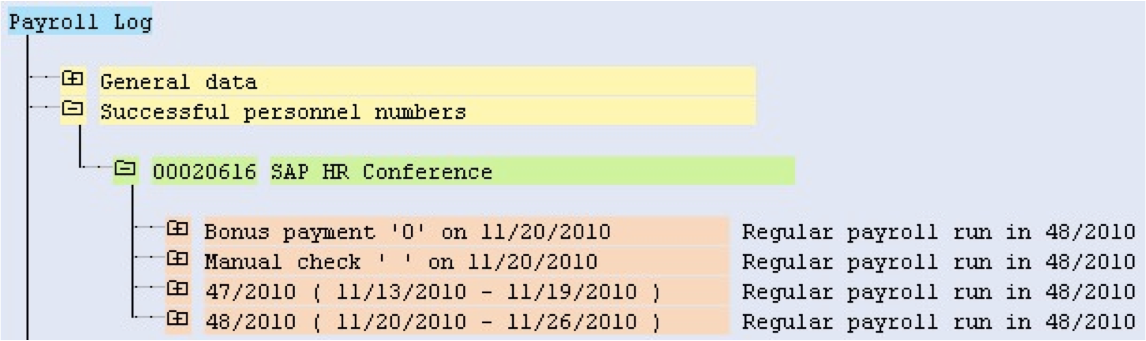
    display payroll log

    Here we can see a successful Payroll log. In this example, an employee processes through payroll without an error. By breaking down the Payroll log, we can see the employee processed through four period, three of which were retroactive.

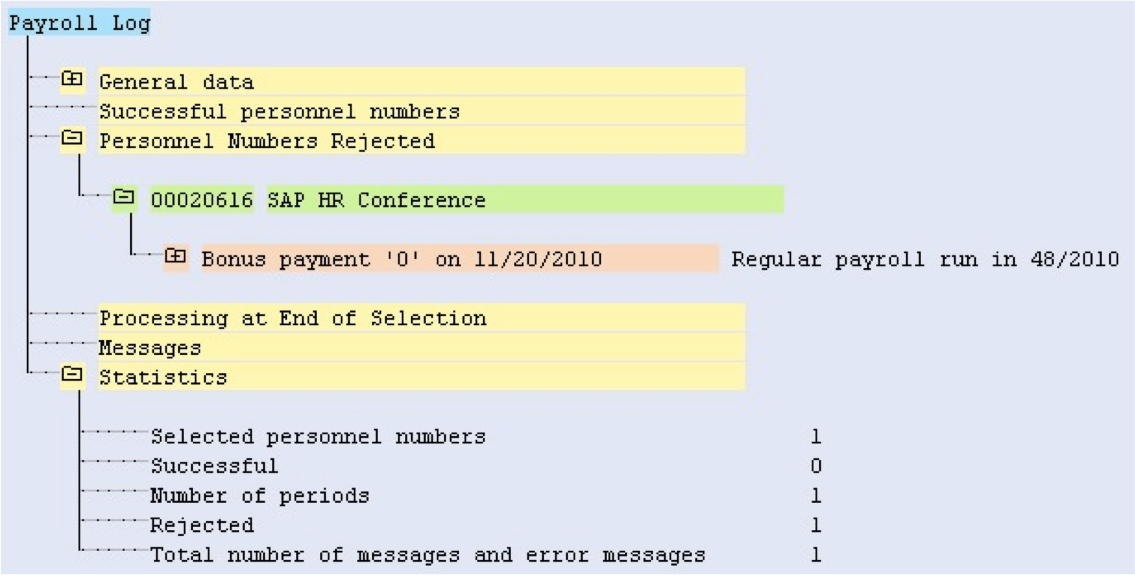
    payroll log retro

    Now let’s throw in a twist. We set Infotype 0207 Residence Tax Authority to IN (Indiana), a state that has not been configured for this company. When we run payroll, this will result in an error for the employee.

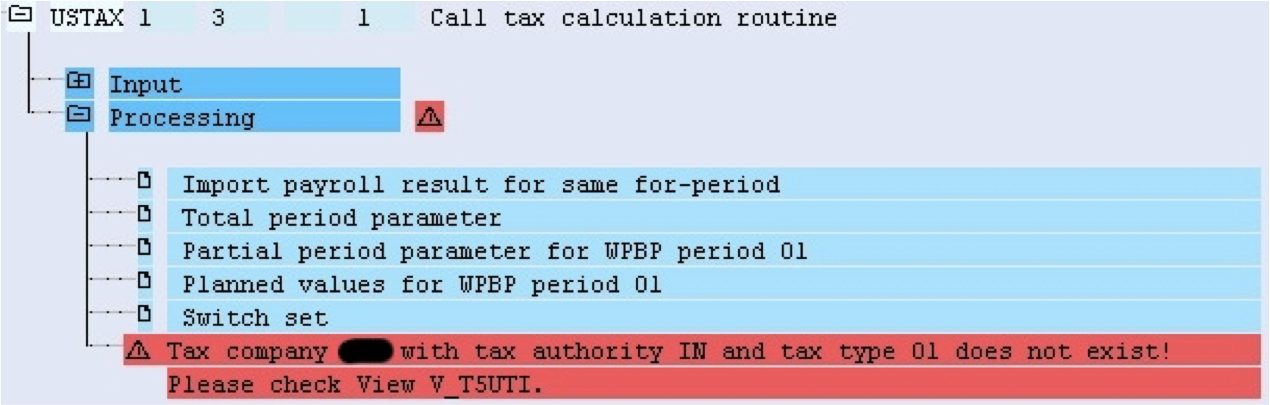
    payroll log error

    When an error like this is received, we need to review the employee paperwork to make sure the Residence Tax Authority should actually be IN. If IN was a typo, change Infotype 0207 to the correct tax authority and process payroll for the personnel number.

    If the employee paperwork shows it should actually be IN, then we need to request an EIN for IN and setup the configuration to allow IN to process through payroll without an error. We will need to add the configuration to the appropriate tax company in table V_T5UTI keeping in mind that the error states only tax type 01, but there may be additional tax types to configure.
    payroll log error

    Implementing the use of proactive audits where possible will reduce the need for reactive error resolution. Here are a few examples of proactive audits that can be put in place:

    • Check that employees have cost centers
    • User exits to validate during time entry
    • Tax infotypes only contain tax authorities set up for the company

    With some patience, willingness to learn, and due diligence, the troubleshooting process can be learned. Keeping in mind the different areas providing input and implementing proactive audits will greatly reduce how much troubleshooting needs to occur.

    Please join us for our next blog post where we’ll discuss Year-end processing as another critical factor in SAP payroll.

    Here at Integrated Consulting Group, we specialize in the design, development, and customization of SAP Human Capital Management business software for leading edge North American companies with global reach. Have any questions about SAP? Feel free to contact us via the contact page of our site, or on Twitter or LinkedIn.

  • 10 most critical factors of SAP payroll: Tax reporting and auditing

    Tax reporting and auditingWe have covered 6 of the 10 most critical factors of SAP payroll in this blog post series. The next area we’ll cover is Tax reporting and auditing.

    Over the years, SAP has developed many payroll reports to make tax reporting and audit simpler process. However, these monthly, quarterly, and annual rituals can consume significant amounts of time and energy from payroll departments depending on the level of understanding of what SAP provides. Hopefully, you are already aware of the following reports you can use to audit your payrolls throughout the year.

    Wage Type Reporter (tcode PC00_M99_CWTR)

    • Data is pulled from the RT and WPBP tables of payroll results selected
    • The report has several organizational structure object options to evaluate the results
    • Unfortunately, tax authority is not available for this report

    Payroll Journal (tcode PC00_M10_CLJN)

    • Payroll results are pulled and displayed in this this easy to use report
    • Selection criteria are very limited and the underlying layout is configured
    • Changes to the layout require the transport process

    Cost Center Report (tcode PC00_MNA_CC_ADM)

    • Managers of cost centers like this report’s availability
    • Detailed payroll charges can be seen and reconciled against FICO reports
    • Unfortunately, there are many HR objects not available for this report

    Payroll Reconciliation Report (tcode PC00_M10_REC)

    • There is a great deal of flexibility in this report, but that flexibility can be confusing
    • Validation of both Tax Reporter and amounts posted to FI are great applications of this report
    • Wage types can be configured as part of a Wage Type Application, which will combine the wage types in display
    • Retro activity in payroll can be easily displayed and tweaked for more informative output
    • The report can be run for specific types of payrolls making for easy identification of Voided checks or specific types of Off-Cycles during a period

    reconciliation report

    • Finally, individuals can create and save the ALV layout of their liking

    Flexible Employee Data Report (tcode S_AHR_61016362)

    • You’ll see this report often used for Birthday lists
    • However, it can provide a great deal of information about the employee population and make year-end validation easier
    • Flexible means you get to pick up to 20 fields to display in the output

    flexible employee data report

    Withholding Allowances Report (tcode S_PH9_46000361)

    • Provides a reconciliation between what an employee has claimed for exemptions in Infotype 0210 W-4 and what is allowed for a tax authority

    Exemption Expiration Report (tcode S_PH9_46000360)

    • Provides information about Infotype 0210 W-4 records that will expire

    Tax Infotype Summary (tcode S_AHR_61016142)

    • Provides tax infotypes information that can be sent to employees for validation

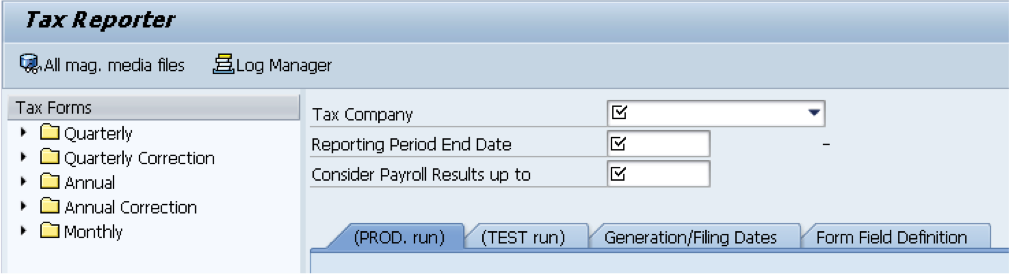
    Tax Reporter (tcode PU19)

    • After validating employee master data and payroll results data, running the tax reporter to validate is the next step
    • If you are using a third-party for tax filing, this is a great way to validate against the data they have
    • Keep in mind you’ll need to configure Tax Reporter in addition to maintaining the third-party programs and tables
    • Review the Log Manager to see if any warnings or errors exist
    • Compare the output of data against the Payroll Reconciliation Report

    pu19

    Using the reports SAP has developed and provided should allow for complete and accurate tax reporting and auditing. Understanding what and how each report works and where it fits in the overall process is very important.

    Please join us for our next blog post where we’ll discuss Troubleshooting as another critical factor in SAP payroll.

    Here at Integrated Consulting Group, we specialize in the design, development, and customization of SAP Human Capital Management business software for leading edge North American companies with global reach. Have any questions about SAP? Feel free to contact us via the contact page of our site, or on Twitter or LinkedIn.

  • 10 most critical factors of SAP payroll: Time management

    We have finished five of the 10 most critical factors of SAP payroll and will explore time management in this post. Time Management includes the collection of time-related data, absences and attendances, and may include evaluation of the raw data all within SAP. SAP delivers several Infotypes to collect data with the most common being:

    • 2001 Absences
    • 2002 Attendances
    • 2006 Absence Quotas
    • 2010 Employee Remuneration Info
    • 2013 Quota Correction
    • 0416 Time Quota Compensation

    These infotypes may be maintained directly, through the use of Cross-Application Time Sheets (CATS), or interfaces from third-party time collection systems. SAP time evaluation is very powerful and flexible, but requires gaining a thorough understanding of business requirements and what SAP time evaluation can do. Time evaluation uses a variety of data elements for processing and generation of output including the aforementioned Infotypes, configuration tables, and schemas and rules that provide the instructions. Once time evaluation is implemented, it is fairly simple to perform.

    Table configuration may be completed by following the steps in the IMG and keep in mind that not all nodes in the IMG are required if specific functionality will not be used, such as Incentive Wages.
    time management configuration

    Work schedules are required for all employees, even those with a fixed working time such as salaried employees. Through configuration working days, working hours, break time, etc. are all defaulted. Flexibility is provided by having groupings based on Personnel area/subarea combinations. In our example, all personnel subareas are set to the same PS grouping 10 since they have the same work schedule conditions.
    work schedules

    Daily work schedules define the planned working time taking into account normal working hours and break schedules. Tolerances may be defined before and after the normal working schedule. In our example, we have defined five daily work schedules and we will look at SFT1 and SFT2 in more detail.
    daily work schedule

    The two daily work schedules are nearly identical with the differences being with the Normal working start time and the Work break schedule.
    daily work schedule

    Period work schedules are the sequence of daily work schedules for a specific number of weeks. Basically, the period work schedule combines daily work schedules into a structure. Period work schedule SFT1 is defined for a one week period and is in the red box. The daily work schedule SFT1 created in the previous step is set for Monday through Friday and daily work schedule FREE is set for Saturday and Sunday.

    Period work schedule SFT6 is defined for a two week period. Week 1 has daily work schedule SFT5 set for Monday through Friday and daily work schedule FREE is set for Saturday and Sunday. Week 1 mirrors the Shift 1 period work schedule, except for the daily work schedule setting. Where things become different is SFT6 has week 2 where Monday is set to a daily work schedule of FREE and the rest of the week is as usual. What this tell us is that the employee associated with this period work schedule will alternate two and three day weekends.
    period work schedule

    Work schedule rules are grouped by Employee Subgroup Groupings, Holiday Calendar, Personnel Subgroup Grouping and defines the options available in Infotype 0007 Planned Working Time. Double-clicking on the record will take you to more details information about the work schedule rule.
    work schedule rule

    During configuration use the dropdowns to select the ES grouping, Holiday Calendar ID, PS grouping, Period work schedule, and rule for day types. You’ll need to manually define the Working time section, which will default fields in Infotype 0007. Under the Work schedule generation section, the Start point in PWS is the week number. In our period work schedule examples we had SFT1 with only one week and SFT6 with two weeks. The Start point in PWS will be 001 when we are setting are using SFT1 as seen below, but could use 001 or 002 if we are using SFT6.
    work schedule rule detail

    Time management has several Infotypes, configuration tables, and uses schemas and rules. All these together are powerful and can provide a great deal of flexibility. Knowing what options are available and using them to the potential has the ability to streamline the payroll process through efficiencies and lessen manual entry. Even if you don’t use SAP delivered time evaluation, the basic time management configuration is necessary for payroll to process.

    Please join us for our next blog post where we’ll discuss Tax reporting and auditing as another critical factor in SAP payroll.

    Here at Integrated Consulting Group, we specialize in the design, development, and customization of SAP Human Capital Management business software for leading edge North American companies with global reach. Have any questions about SAP? Feel free to contact us via the contact page of our site, or on Twitter or LinkedIn.

  • 10 most critical factors of SAP payroll: Unit and parallel testing

    Unit and Parallel TestingUnit and parallel testing is the fifth factor in the 10 most critical factors of SAP Payroll. We covered Data integrity, Integration, Configuration and Customization, and HRSP and legal changes in the first four blog posts.

    Testing is a building process where we look at individual functionality and see how it fits in the big picture. We can then identify how the process changes when moving from another system or by changes to the SAP system. How do are the differing levels of testing defined and what should levels should we go through?

    Unit testing is the validation of individual functionality. Unit tests are typically performed by the technical or functional support team. Those team members should understand the business process.

    If your support is outsourced, the outsourced team members should have an understanding of your specific business processes because general knowledge will not provide a specific enough understanding to your business processes and requirements. Many times, outsource team members are viewed as only technical or configuration, but their understanding will impact the effectiveness of functionality.

    Integration testing is the validation of aggregate functionality by combining individual functionality. Integration testing is best performed by a mix of the support team and business users.

    Parallel testing is the validation of data through concurrently testing functionality. Similar to integration testing a mix of support team and business team members is best.

    Finally, we have User Acceptance testing where our Subject Matter Experts along with key users should review the functionality and validate that it will support the business processes and meet their requirements. The SMEs and business users should be able to perform all of the processes and identify breakdowns.

    All stages of testing should be performed to provide a complete testing methodology. Unfortunately, when timelines are short it is not uncommon for testing to be shortchanged. The short-term gain may likely be outweighed when fallout is found in production and the result is incorrect employee remunerations. The best run projects will keep testing scopes intact and provide sufficient time and resources to verify business processes and requirements are met.

    Please join us for our next blog post where we’ll discuss Time management as another critical factor in SAP payroll.

    Here at Integrated Consulting Group, we specialize in the design, development, and customization of SAP Human Capital Management business software for leading edge North American companies with global reach. Have any questions about SAP? Feel free to contact us via the contact page of our site, or on Twitter or LinkedIn.